Building Resilience: The Early Lessons That Shaped a Career
As her youth unfolded, Amber Buker hopscotched across the country. She was born in Fort Smith, Ark., and raised in Tulsa, Ok.; other homesteads included those in Portland, Ore., and Nashville, Tenn. She attended eight different schools by the time she was a preteen.
“I learned to adapt quickly,” she says.
That early instability taught me resilience, how to read people fast, and how to communicate well in any room.
A resulting outlook of sheer grit became her foundation of a career defined by initiative, intellect, and crafting connections. Whether serving tables while hunting for her first job in law, starting a theater company, or launching a Native-led fintech, Buker developed a knack for listening, considering, synthesizing, and then strategizing.
She now brings a unique professional perspective shaped by interviewing 300+ bank leaders and working side-by-side with fintechs and community banks alike. “I’m not afraid to get in the weeds,” she says. “I’ve been on the whiteboard sessions with CEOs, helped them articulate product strategies, and translated innovation into results.”
The Path to Banking: From Law School to Financial Media
Buker earned a J.D. from Lewis & Clark Law School, Portland, while working 35–40 hours a week.
In those early years, she developed a sharp eye for what she wanted and a steely spine to get it. Her first legal position, for example, came her way when she advantageously approached a restaurant customer.
“I was working as a waitress,” she says, “and I saw that a local district attorney was coming in with a large party. And I said to my fellow crew of waitstaff, ‘Back off that table. That’s mine.’”
As the table’s server, Buker made sure to provide an A-one experience. Before they could even signal her for more bread or a top-off of a drink, she was there, filling the need.
As she presented the check, she leveraged her way into an opening. “I don’t know if you have any openings for a tenacious person,” she said to the host, “but if you do, I’m your person.”
The District Attorney immediately invited her to his office, where he told her he had no appropriate opening at that time. “But,” Buker reveals, “three months later, I got hired.”
She held down that position while still navigating college. “I managed to work for the district attorney’s office,” she states, “just because I wasn’t afraid to ask a straightforward question.”

After graduating, she spent the last semester of law school doing an externship at a nonprofit. She parlayed that experience into a job, supporting low-income creatives and entrepreneurs. She eventually passed the bar in Nashville and practiced at the nonprofit in the following years.
A Cold Email to Bank Director Magazine
One of her responsibilities at the nonprofit was a cold email campaign that she launched. It eventually caught the attention of Bill King, founder of Bank Director magazine. The message wasn’t meant as a job hunt, but her compelling writing and creative approach garnered his attention. “I thought he wanted to buy our program. Turns out, he wanted to hire me,” she laughs. She was prime for the career switch. “Nonprofit burnout is a real thing,” she recalls.
Following an impromptu lunch with King, a new chapter in financial media opened. At Bank Director, Buker quickly grew beyond sales and began writing about fintech partnerships.
Her Bank Director duties eventually expanded into leading the development of the FinXTech Connect. This database of bank-friendly fintechs helps bank leaders understand the various vendors and solutions other institutions use. “The disconnect between banks and fintechs was huge back then,” she says. “But it was clear to me that the two needed each other. I focused on telling those stories so banks could partner more effectively.”
Working with Banking’s Top Innovators
Buker’s time at Bank Director opened doors to deeper roles in financial innovation. At Minneapolis-based Alloy Labs Alliance (a banking innovation consortium and fintech investment network), she led content development for banks focused on emerging technologies. Buker translated the strategic thinking of bank CEOs into clear, actionable frameworks.
She describes her work there: “It’s hard to explain, but imagine a bunch of bank CEOs in a virtual room, comparing notes. They could be analyzing what current ‘digital table stakes’ are or building a shared standard for third-party diligence. They were collaborating to build assets that all banks could use, so that they weren’t each reinventing the wheel.
“It was super hands-on, and my job was to turn those discussions into something clear and usable. Not many jobs let you be in the room for those conversations, let alone shape how the outcomes get communicated. That was a big deal for me.”
The Lessons of Building a Niche Bank
Buker then founded Totem, a digital bank focused on serving Native American communities.
As an enrolled member of the Choctaw Nation of Oklahoma, Buker was building from experience. “Not only are we the largest group of unbanked people in the country, according to the 2019 FDIC survey, we have something other underserved groups don’t—tribal governments,” she says. “Tribal nations are economic engines that generate significant revenue and use that to support their members, often through direct payments. But the financial infrastructure most tribes use to deliver those payments had long been inadequate. I saw an opportunity to build something that upheld tribal sovereignty and delivered real value.”
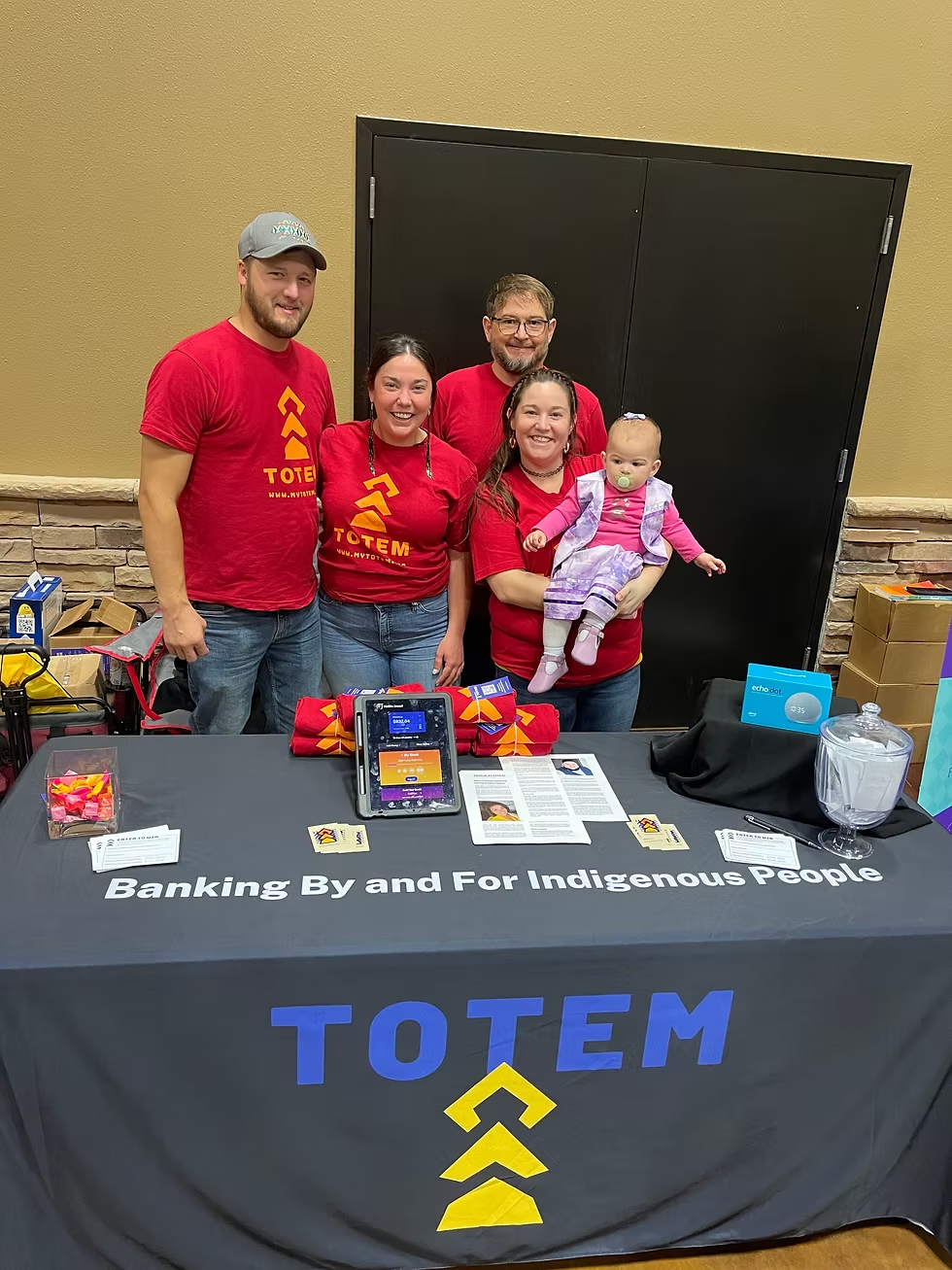
She developed an innovative funds flow model with her partner bank, launching the product.
“In 2022 I raised over $2 million for the company’s pre-seed round, making me (I believe) only the second indigenous woman in the U.S. to raise a multi-million-dollar venture round.”
The Challenges of a Digital Bank Startup
But in its infancy, the business was beset with difficulties.
Although she exhibited the savviness to propel a niche bank, Buker’s drive wasn’t enough to avert greater problems. Totem ultimately collapsed due to a combination of insufficient capital and the unexpected withdrawal of a key institutional partner.
The startup institution did, however, provide Buker with firsthand experience in banking-as-a-service and the subtleties of product-market fit.
“I’ve learned how to build from scratch, how to sell vision when the product is still an idea, and how to pivot,” she characterizes. “That’s the kind of experienced voice I now bring to every client conversation.”
Shaping Travillian’s Content and Consulting
Buker’s newest role is as Chief Research Officer for Travillian, a nationally focused executive search, strategy, and talent advisory boutique, dedicated to exclusively serving the financial services industry. There, she draws on a rare blend of legal, creative, and fintech experience to drive the company’s content and consulting strategies.
“We’re building on the solid content foundation Travillian started in 2020,” Buker explains. “But now we’re taking it deeper — using research to create frameworks that help banks grow, differentiate, and compete.”
Under Buker’s direction, Travillian is helping banks cut through the noise around compensation and talent strategy. “There’s a lot of noise right now — what roles to prioritize, how to structure comp, whether to follow peers or break from the pack,” she notes. “We help institutions make clearer, more confident decisions.”
That clarity, she adds, is why Travillian has become a go-to thought leader for talent strategy in innovative banking.
In addition, she advises banks on fintech partnerships, innovation readiness, and niche product strategies that can drive revenue. “I know what it’s like to build a product. That lets me ask better questions and give more useful feedback,” she says.
Buker’s arrival expands Travillian’s strategic advisory offerings. “We’re not just recruiters,” she observes.
We’re strategic partners who understand what talent, tech, and timing can do together. My goal is to help banks find their edge — then own it.
Unifying Travillian’s Voice for Industry Leaders
The addition of Buker to Travillian coincides with the firm’s reorganization of its content strategy under the umbrella of Travillian Communications. Unifying the firm’s messaging under one brand voice will be one of her early challenges. But she is up to the task.
She notes: “Before the idea to bring uniformity to Travillan’s messaging, there were already all these great communications tools: Banking+, the podcasts, the Next Forum…. Part of my job is to connect those channels and build in the processes that will allow our partners to connect with the audience of bank leaders we’ve built up over the years. I’m looking to help us evolve beyond a marketing platform and into a leading voice, shaping the industry’s conversations around leadership, innovation, and talent.”
A Strategic Partner for Your Bank
To Buker, the lines between recruiter, researcher, and advisor are fluid. Her goal is to help banks compete not just on capital, but on creativity. “Too many banks still default to peer strategies,” she warns. “But the successful ones will be those who figure out their unique angle and lean into it.”
She invites bankers to view her not just as a vendor, but as a partner. “If you want to experiment, to modernize, to grow your brand and voice in the market, I want to help you do it in a way that’s strategic, not just shiny,” she says. “Let’s talk about where your bank is trying to go — and whether you have the story, the strategy, and the team to get there.
“That’s what I love: bringing structure to ambiguity and momentum to great ideas.”
As she looks ahead, Buker urges C-suite leaders to resist reactive decision-making and instead lead with clarity and conviction. “Don’t move just because the market is shifting or peers are trying something new,” she advises.
In a time of constant noise and disruption, she believes the real edge lies in thoughtful strategy, internal alignment, and dedicated follow-through. “Know who you are, what problem you’re solving, and make sure your people can tell that story clearly,” she concludes.